Essay
Why Movies Keep Asking: "What If Your Memories Were Wrong?"
Memory feels like a recording, but it's a reconstruction, and movies keep proving it by rewriting your memory of the film while you watch it.
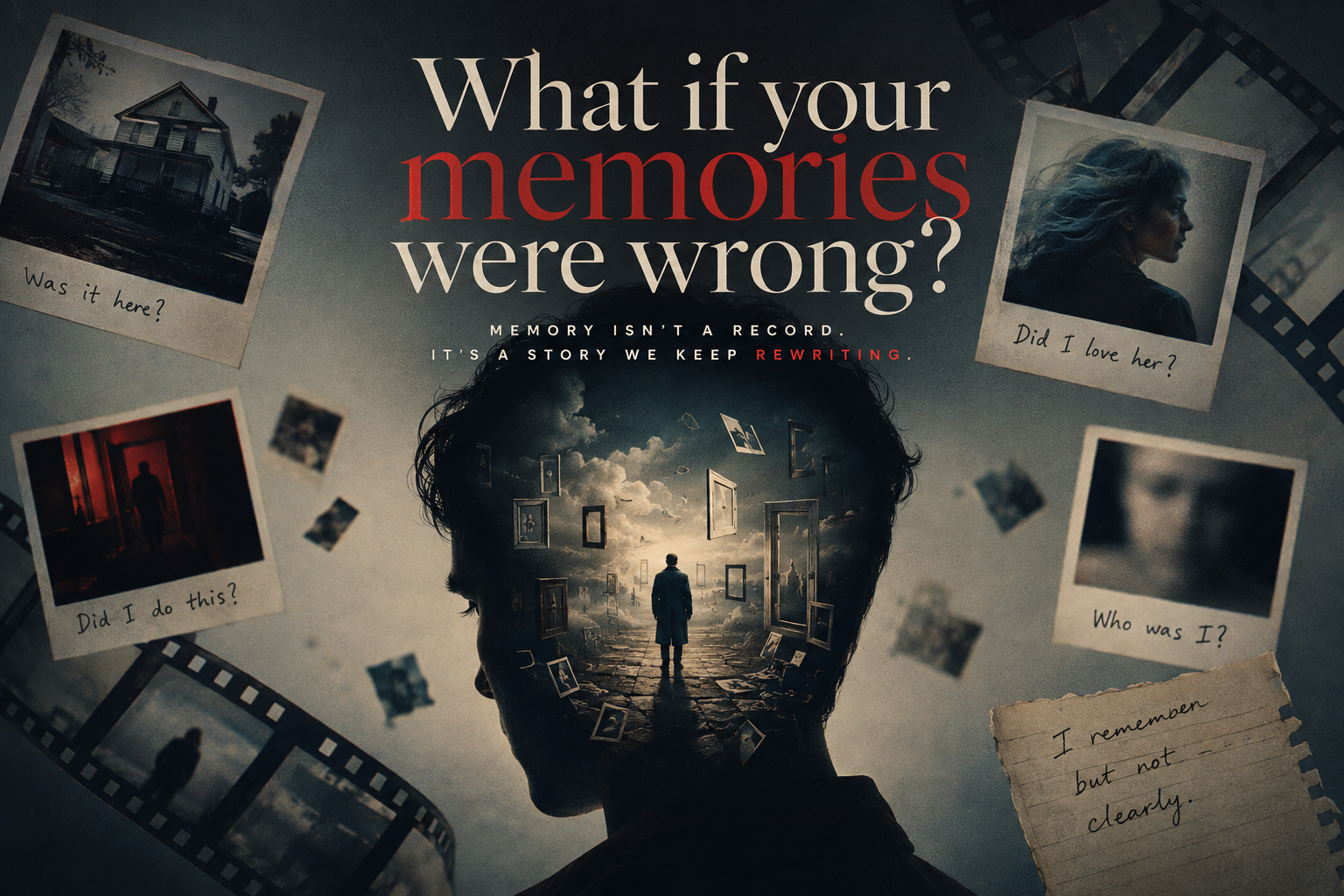
Ask someone how memory works and most will describe something like a security camera. Events happen, the brain files them away, and recall is just pressing play. It's a comforting model. It's also wrong, and has been known to be wrong since the 1930s, when Frederic Bartlett had people read a Native American folk tale and then recount it weeks later. Nobody reproduced the story. Everybody reconstructed it, smoothing out the parts that didn't fit their own cultural expectations, inventing details that felt true even though they weren't there.
Film noticed this before neuroscience gave it a name. Vertigo is built around a man who falls in love with a woman he's convinced he remembers correctly, when what he actually loves is a version of her he's assembled from grief and projection. Hitchcock doesn't frame this as pathology. He frames it as what love does to memory generally. You don't recall a person, you recall your best available draft of them.
What Neuroscience Already Knew Before Nolan Did
By the time Memento came out in 2000, researchers had already established something called reconsolidation. Every time a memory is retrieved, it becomes briefly unstable and gets re encoded, slightly altered, before being filed away again. You're not accessing the original event. You're accessing your last remembering of it, with whatever mood, bias, or new information got mixed in that time.
Leonard Shelby's condition in Memento is presented as a disorder, a man who can't form new long term memories and has to tattoo facts onto his own skin. But strip away the extremity and his situation just describes everyone's relationship to the distant past, run at high speed. He builds a narrative from fragments and evidence, the same way you or I build a story about our own childhood from a handful of photographs and a few oft repeated family anecdotes, most of which we can no longer distinguish from things we actually witnessed.
The Twist as a Memory Edit You Didn't Consent To
Here's the angle criticism tends to skip. The reveal in a memory thriller doesn't just inform the character. It performs surgery on the audience's own memory of the film they just watched.
When The Sixth Sense recontextualizes every prior scene, your brain doesn't file the twist as new information sitting next to the old scenes. It goes back and edits them. Ask someone a week later to describe the dinner table scene between Bruce Willis and his onscreen wife, and they'll often "remember" him speaking, gesturing, being acknowledged, details the edit never actually gave you, but that your memory quietly inserted to make the story cohere. The film doesn't just depict false memory. It manufactures one in you, live, in the theater. That's a strange thing for a piece of entertainment to be capable of, and almost nobody talks about it as the film's real trick, as opposed to the twist itself.
Editing Is Memory's Native Language
There's a reason this genre belongs to film specifically rather than the novel. A book has to describe a jump cut; a movie just does one. The cut, the fact that scene B follows scene A with no acknowledgment of the gap between them, is already a lie about continuity that audiences have agreed to accept since 1903. We've spent over a century training ourselves to stitch discontinuous fragments into a smooth, felt sense of "what happened," which is exactly the operation memory performs on lived experience.
Eternal Sunshine of the Spotless Mind just makes the metaphor literal by having its editing become the plot. Rooms collapse, faces blur, a beach house erases itself book by book as Joel's memories of Clementine get deleted in reverse chronological order. But even a film with no science fiction premise at all is doing a version of this every time it cuts from a wide shot to a close up and expects you to believe you're still watching one continuous moment. Cinema didn't borrow the structure of memory as a theme. It was built out of the same material to begin with.
The Audience's Own False Memories
Push this further and something uncomfortable shows up: audiences generate false memories about movies themselves, at scale. Ask enough people about Shazaam, a supposed 90s Sinbad genie film, and you'll find a community convinced they watched it, quoted lines from it, owned it on VHS, despite it never having existed. It's the same mechanism Bartlett found with his folk tale, except now the source material is collective and mediated by pop culture rather than personal experience.
Filmmakers who build plots around unreliable memory are, in effect, dramatizing a glitch their own medium is uniquely prone to causing. The theater is a controlled environment for installing false memories, and it's been doing this to willing customers for over a hundred years, mostly for two hours' worth of pleasure at a time.
Why We Keep Returning to the Same Question
The tidy explanation is that unreliable memory films let audiences enjoy a puzzle. Piece together what "really" happened, feel smart when it clicks. That's true but incomplete. The deeper pull might be closer to relief. If Leonard Shelby's memory is unreliable, if Teddy in Shutter Island has built an entire alternate identity to survive what he did, if Rachael in Blade Runner has memories that were manufactured wholesale and still feel like hers, then the gap between what we remember and what happened stops being a personal failing and becomes just how minds work, always, for everyone.
That's the quiet comfort under all the paranoia these films traffic in. Not that memory can be trusted, but that nobody's ever really had it to begin with, so there's nothing uniquely broken about you.