
Essay
The Power of Ambiguity: Why Great Cinema Refuses to Explain Everything
Ambiguity gives great cinema its lasting power because the story continues to evolve in the audience's mind long after the film has ended.
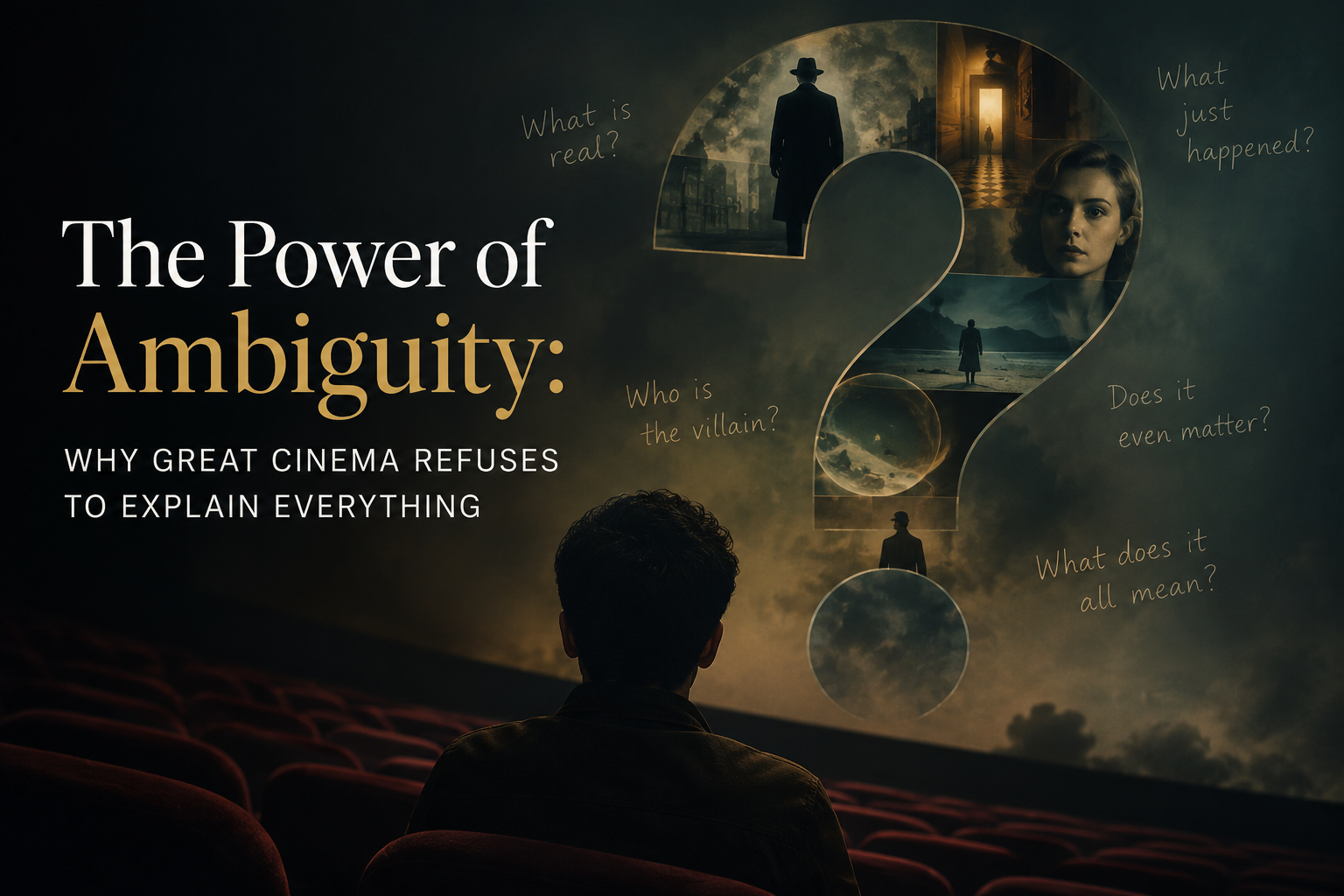
There is a reason certain films continue to occupy our minds years after we watch them. We revisit scenes, replay conversations, and find ourselves reading other people's interpretations. The experience doesn't end with the closing credits. It quietly extends into our own thoughts.
That lingering effect rarely comes from a neatly wrapped conclusion. More often, it comes from uncertainty.
Many stories are built around the promise of resolution. A mystery is solved, the hero wins, and every important question finds an answer. There is nothing inherently wrong with that approach. Closure can be satisfying because it gives us the feeling that the journey is complete.
Great cinema, however, often chooses a different path. Instead of explaining every detail, it leaves room for doubt. It trusts the audience to sit with uncertainty instead of rushing toward certainty.
Ambiguity is not the same as confusion
Ambiguity is sometimes dismissed as vague storytelling, but the two are very different.
A confusing film leaves viewers wondering whether information is missing. An ambiguous film presents enough information to support more than one interpretation. The uncertainty is intentional because the film is asking the audience to think beyond the obvious.
That distinction explains why certain films invite discussion for decades while others are simply forgotten. The unanswered questions are not flaws waiting to be fixed. They are part of the experience the filmmaker wants us to have.
When ambiguity is used well, it shifts the audience from passive viewers to active participants. We stop asking, "What did the director forget to tell us?" and begin asking, "What does this mean to me?"
The audience becomes part of the story
One of the most fascinating examples is Inception.
The spinning top in the final scene has inspired countless debates. Did Cobb return to reality, or was he still dreaming? Christopher Nolan could have answered that question with a single shot. Instead, he ends the film a moment earlier.
That decision changes the relationship between the audience and the story. Instead of delivering a definitive answer, the film invites every viewer to weigh the evidence and arrive at a personal conclusion. The ending becomes less about solving a puzzle and more about reflecting on the emotional journey that led there.
A similar idea appears in Burning. The central mystery remains unresolved, but the uncertainty gradually redirects our attention toward class, isolation, jealousy, and the stories people tell themselves. Solving the mystery becomes less important than understanding the characters who are trapped inside it.
In both films, ambiguity expands the conversation instead of ending it.
Why our minds resist unanswered questions
Our brains are naturally drawn toward certainty. Psychologists describe this tendency as the need for cognitive closure. We prefer explanations because they reduce mental tension and help us make sense of the world.
Cinema occasionally works against that instinct.
When a film refuses to provide complete answers, our minds continue searching for meaning even after the screen goes dark. We replay scenes, notice overlooked details, and reconsider earlier assumptions. The film stays alive because our interpretation keeps evolving.
That is one reason ambiguous films are often rewarding on a second or third viewing. Once we stop looking for a single solution, we begin noticing themes and emotional details that escaped us the first time.
Some ideas cannot be explained directly
Certain subjects lose their power when they are explained too clearly.
Take 2001: A Space Odyssey. Stanley Kubrick fills the film with striking imagery while offering very little direct explanation. The monolith, the final transformation, and the silence of space continue to inspire discussion because they resist simple interpretation.
If Kubrick had explained every symbol through dialogue or narration, the film would probably feel smaller. The mystery allows each viewer to engage with ideas about evolution, consciousness, and humanity from a different perspective.
The same can be said about Mulholland Drive. Many first-time viewers try to arrange every scene into a logical sequence. Yet the film becomes richer when it is approached as an emotional experience rather than a puzzle with one correct solution. David Lynch leaves enough space for the audience to connect the story with their own understanding of dreams, memory, and identity.
The temptation to explain everything
Modern audiences have become accustomed to instant explanations. A film ends, and within minutes there are articles and videos promising to decode every hidden detail.
Sometimes those interpretations are genuinely insightful. At other times, they reduce a complex work into a single "correct" answer.
That approach can unintentionally narrow our experience of cinema.
Art often gains its emotional weight because different viewers bring different experiences into it. Someone watching a film after a personal loss may notice something completely different from another viewer who is seeing it during a happier period of life. Neither interpretation is necessarily wrong. The film has enough depth to accommodate both.
Searching for one final explanation can close a conversation that was never meant to have a final word.
Why ambiguity keeps great films alive
There is a reason people still discuss films like No Country for Old Men decades after their release. The ending does not deliver the conventional emotional payoff many viewers expect. Instead, it leaves us reflecting on fate, aging, violence, and the limits of justice.
Those questions remain relevant because they have no permanent answers.
Perhaps that is the greatest strength of ambiguity. It allows a film to grow alongside its audience. A story that seemed mysterious in our twenties may feel deeply personal years later because our own experiences have changed. The film itself remains the same, but our perspective does not.
Great cinema refuses to explain everything because life rarely explains everything. We move forward without complete certainty. We carry unanswered questions about people, relationships, and ourselves. Films that acknowledge this uncertainty often feel closer to lived experience than stories where every thread is neatly tied together.
Their lasting power comes from what they leave behind. Not a solved puzzle or a final answer, but an invitation to keep thinking.